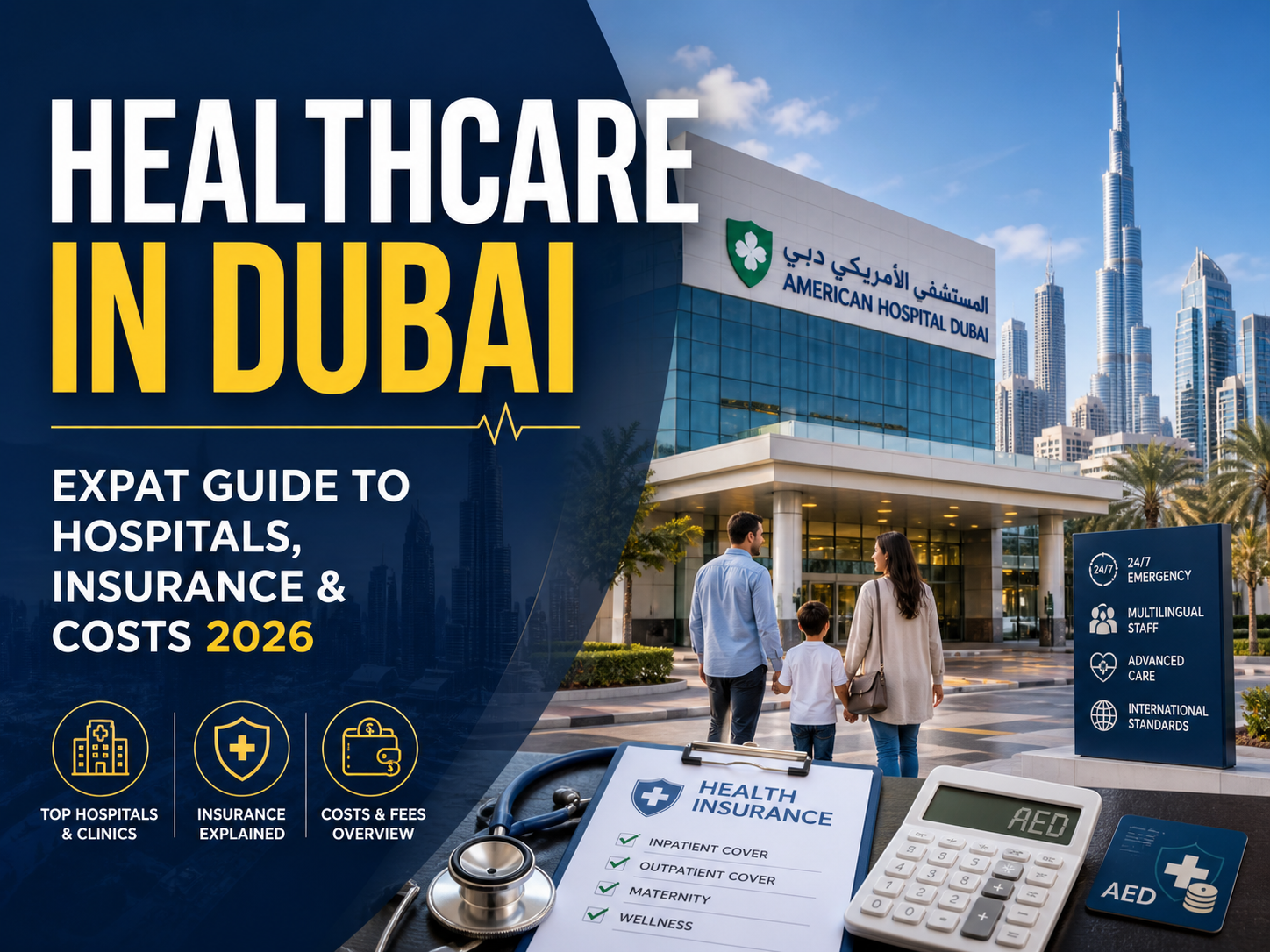
Healthcare in Dubai: Expat Guide to Hospitals, Insurance & Costs 2026
Disclaimer: Healthcare regulations, insurance requirements, and hospital costs change. This guide is for informational purposes only. Consult a licensed UAE insurance broker for personalised insurance advice.
Introduction
Healthcare in Dubai is mandatory and employer-provided — legally, every employer in Dubai must provide health insurance for all employees. The system works, but there are significant gaps and limits that catch expats by surprise: pre-existing condition exclusions, low-cost employer policies with minimal coverage, long GP referral chains before you see a specialist, and costs that escalate rapidly for anything dental, optical, or maternity-related.
This guide explains how the Dubai health system actually works for expats, which hospitals are worth knowing, what your insurance likely covers (and doesn't), and what to budget for out-of-pocket.
How Healthcare in Dubai Works
Dubai operates a mandatory health insurance system regulated by the Dubai Health Authority (DHA) for Dubai residents, and the Health Authority Abu Dhabi (HAAD) for Abu Dhabi residents.
Key rules:
- All employers must provide health insurance — it's a legal requirement. Failure to do so is a violation of UAE labour law.
- Insurance must be active before or at the start of employment
- Employers who do not provide insurance can face fines of AED 500 per employee per month
- Coverage must meet the Essential Benefits Plan (EBP) minimum — a baseline that covers outpatient, inpatient, maternity, and emergency care
The problem with basic employer insurance: The EBP minimum is intentionally a floor, not a ceiling. Basic employer plans often have:
- AED 150,000–300,000 annual coverage limits (inadequate for serious illness)
- High co-payment rates (20–30% of each visit)
- Restricted hospital networks (only specific DHA-listed clinics, not the best hospitals)
- Pre-existing condition exclusions for 6–12 months
- No dental, no optical, no preventative care
Always read your policy document before you need it.
Types of Health Insurance in Dubai
Basic Employer Insurance (EBP)
The legal minimum. Covers inpatient and outpatient at approved facilities, maternity, and emergency. Most large employer plans fall just above this level.
Co-pay: Typically AED 20–50 per GP visit, AED 50–100 per specialist visit.
Best for: Low-risk individuals with no chronic conditions and no dependants.
Enhanced Employer Insurance
Larger companies (international corporations, government entities, banks) often provide significantly better plans — no network restrictions, direct billing at all major hospitals, lower or zero co-pays, dental and optical included.
Ask your HR: What specific hospitals are covered? Is there a co-pay? Is dental included? What is the annual limit?
Individual / Family Top-Up Insurance
For families, self-employed individuals, or anyone with gaps in employer coverage. Allows you to access better hospitals, add dental and optical, and increase annual limits.
Cost: AED 3,000–15,000/year depending on age, coverage level, and pre-existing conditions.
Best providers for expats: Daman, Cigna, AXA Gulf, MetLife UAE, Allianz Care.
Best Hospitals in Dubai for Expats
Medcare Hospital (Multiple Locations)
Good general coverage, multiple specialties, modern facilities, English-speaking staff throughout. Network coverage with most major insurance plans. Al Safa location is most accessible.
American Hospital Dubai (Oud Metha)
JCI-accredited, American-standard protocols, strong reputation for complex cases, cancer centre. Higher co-pays than government hospitals but quality is reliable. Board-certified physicians from the US and international markets.
King's College Hospital Dubai
UK standard of care, NHS-trained physicians, strong emergency department. Multiple locations across Dubai. Direct billing with most major insurance companies.
Mediclinic (Multiple Locations)
South African-founded international chain. Reliable, clean, modern, English-language throughout. Good for outpatient and specialist visits.
Cleveland Clinic Abu Dhabi
Worth noting for serious cases — the UAE's top-rated hospital by international standards. Not in Dubai but accessible and worth the travel for complex diagnoses.
Government Hospitals (DHA Hospitals)
Dubai Hospital, Rashid Hospital, Latifa Hospital — government-operated, lower costs, and the go-to for emergency cases. Rashid Hospital has one of the UAE's best trauma centres. Wait times can be long for non-emergency outpatient.
Costs Without Insurance (Out of Pocket)
If you need to pay out of pocket (waiting for Emirates ID, between jobs, visiting on a tourist visa):
| Service | Typical Cost |
|---|---|
| GP consultation (private clinic) | AED 150–350 |
| Specialist consultation | AED 350–700 |
| Blood test panel | AED 150–500 |
| X-ray | AED 200–500 |
| MRI | AED 1,200–2,500 |
| Emergency room visit (minor) | AED 500–1,500 |
| Emergency room visit (admitted) | AED 5,000–50,000+ |
| Dental cleaning and checkup | AED 300–600 |
| Dental filling | AED 200–500 |
| Dental crown | AED 1,500–4,000 |
| Maternity (vaginal delivery, private) | AED 15,000–35,000 |
| Maternity (C-section, private) | AED 25,000–60,000 |
Key takeaway: UAE private healthcare is expensive for uninsured visits. Travel insurance covering emergency medical care is non-negotiable for short-term visitors.
What Employer Insurance Usually Does NOT Cover
Read your policy for these common exclusions:
- Dental: Almost always excluded from basic plans (or limited to extraction only)
- Optical: Excluded from most basic and mid-tier plans
- Pre-existing conditions: Often excluded for 6–12 months after policy start
- Maternity (beyond basic): Enhanced maternity rooms, specific hospitals, elective C-section — often excluded or capped
- Mental health: Limited or excluded on many employer plans (improving as regulations evolve)
- Physiotherapy: Often requires prior authorisation and is capped at a small number of sessions
- Cosmetic procedures: Always excluded
Maternity and Prenatal Care in Dubai
Pregnant expats need to plan actively:
Government option: DHA hospitals (Latifa Hospital is the main government maternity hospital) — lower cost, longer wait times, English-speaking staff.
Private option: American Hospital, King's, Mediclinic — English-language OBGYN, private rooms, higher cost.
Typical maternity package costs (private, 2026):
- Standard vaginal delivery: AED 15,000–35,000 (facility + doctor)
- C-section: AED 25,000–60,000
Check whether your insurance covers maternity — many basic plans have a 12-month waiting period before maternity benefits activate.
Emergency Procedures
For life-threatening emergencies: Call 998 (Dubai Ambulance). State your location clearly. Most major areas are well-covered.
Rashid Hospital is the primary trauma and emergency centre in Dubai. Government-operated, highest-volume emergency department.
Insurance and emergencies: In a genuine emergency, go to the nearest hospital — your insurer cannot refuse retrospective coverage for emergency treatment even if the hospital is not in your network. Always notify your insurer within 24–48 hours of emergency treatment.
Medical evacuation: For complex cases, medical evacuation insurance (often included in premium plans or international health insurance) covers transport to a more advanced facility. Worth having, especially with children.
Frequently Asked Questions
Is healthcare free in Dubai for residents?
No. Healthcare is privately funded via mandatory insurance. Government hospitals exist but are not free for expatriate residents (they are subsidised but require payment or insurance). Only UAE nationals receive free government healthcare.
What should I do if my employer's insurance doesn't cover my doctor?
Ask your HR for the list of in-network hospitals. If your preferred doctor is out-of-network, you can pay out of pocket and seek reimbursement (if your plan covers out-of-network) or switch to an in-network alternative.
Can I use my home country's travel insurance in Dubai?
Yes for short visits. Travel insurance typically covers emergency treatment. Not adequate for long-term residency — UAE mandatory insurance must be in place for residents.
How do I find a good doctor in Dubai?
The DHA has a healthcare provider directory at dha.gov.ae. Zocdoc and HealingCloud also list Dubai-based doctors with reviews. Ask expat community groups for personal recommendations — the quality difference between individual doctors within the same hospital is significant.
Full expat guide: Moving to Dubai: Expat Guide 2026 → | UAE Health Insurance comparison: UAE Health Insurance for Expats →