Buying Property in Dubai: Complete Guide for Expats & Investors [2026]

Legal Disclaimer: This guide is for general informational purposes only. Property laws, fees, and regulations change. This is not legal or financial advice. Always engage a RERA-licensed real estate agent, a qualified UAE lawyer, and a licensed financial adviser before making a property purchase decision.
Introduction
Dubai is one of a small number of global cities that actively welcomes foreign property ownership. Since the landmark Freehold Decree of 2002, non-UAE nationals can purchase property with full ownership rights in designated zones — no local sponsor, no expiry date, no upper limit on the number of properties you can hold.
In 2026, Dubai's property market continues to attract significant international investment. Rental yields of 5–9% in well-located areas, zero capital gains tax, zero property tax, and a transparent regulatory framework (enforced by the Dubai Land Department and RERA) make the numbers genuinely competitive against almost any global market.
But buying property in Dubai has specific processes, costs, and risks that differ from buying in Europe or North America. This guide walks through everything you need to know.
Can Foreigners Buy Property in Dubai?
Yes — with one key qualification. Foreign nationals can only purchase freehold property in designated freehold zones. Outside these zones, property is restricted to UAE and GCC nationals.
Freehold zones include (but are not limited to):
- Downtown Dubai
- Dubai Marina and JBR
- Palm Jumeirah
- Business Bay
- Jumeirah Village Circle (JVC)
- Dubai Hills Estate
- Arabian Ranches
- DAMAC Hills
- Meydan / Mohammed Bin Rashid City
- Dubai Creek Harbour
- Jumeirah Golf Estates
- Dubai South
The Dubai Land Department (DLD) maintains the official and current list. New areas are periodically added by decree.
Key rights of freehold ownership:
- Full ownership of the unit and proportional share of common areas
- Right to sell, lease, mortgage, or gift the property
- Right to pass property to heirs
- No time limit — ownership does not expire
Types of Property Ownership
Freehold
Full ownership in perpetuity. The standard for international buyers in designated zones. Strongest legal protection.
Leasehold
Right to use a property for up to 99 years. Found in some older communities and areas outside designated freehold zones. Less common for new purchases.
Off-Plan
Buying a property that is under construction or not yet built. Paid via instalments to the developer (typically 10% deposit, then milestone-based payments during construction, balance on handover). Offers lower entry prices and potential capital appreciation before completion — but carries developer risk.
The Dubai Property Buying Process: Step by Step
Step 1: Define Your Budget (Including All Costs)
Purchase price is not the only cost. Add 7–8% on top for the total transaction:
- DLD Registration Fee: 4% of purchase price
- Agent Commission: 2% of purchase price
- Trustee Office Fee: AED 4,000 (properties above AED 500,000)
- NOC Fee: AED 500–5,000 (developer-specific)
- Mortgage registration (if applicable): 0.25% of loan amount + AED 290
- Conveyancing/legal fees (optional but recommended): AED 5,000–15,000
Example: AED 1,000,000 apartment = purchase price + AED 70,000–80,000 in fees.
Step 2: Choose Your Area and Property Type
Decide between off-plan and ready (see section below). Research the developer's track record for off-plan. Engage a RERA-licensed agent — verify their licence on the RERA website before signing anything.
For area-by-area guidance on which neighborhoods suit which lifestyle: Best Areas to Live in Dubai →
Step 3: Make an Offer and Sign the MOU
Once you've found a property and agreed on price, you sign a Memorandum of Understanding (MOU) — also called Form F for secondary market properties. Pay the 10% deposit at this stage (held by the agent or a conveyancer).
Step 4: Apply for NOC (No Objection Certificate)
The seller applies for an NOC from the developer confirming there are no outstanding service charges on the property. This takes 5–15 business days and costs AED 500–5,000 depending on the developer.
Step 5: DLD Transfer
Both buyer and seller (or their representatives with Power of Attorney) attend the DLD Trustee Office together. Remaining purchase price is paid (via manager's cheque or DLD-approved payment method). DLD issues the Title Deed in your name. Process takes 1–3 hours on the day.
Step 6: DEWA and Service Charges Transfer
Connect electricity and water in your name via DEWA (AED 2,000–4,000 deposit). Confirm service charge account transfer with the owners association.
Total timeline for a secondary market (ready property) purchase: 2–6 weeks from signed MOU to Title Deed.
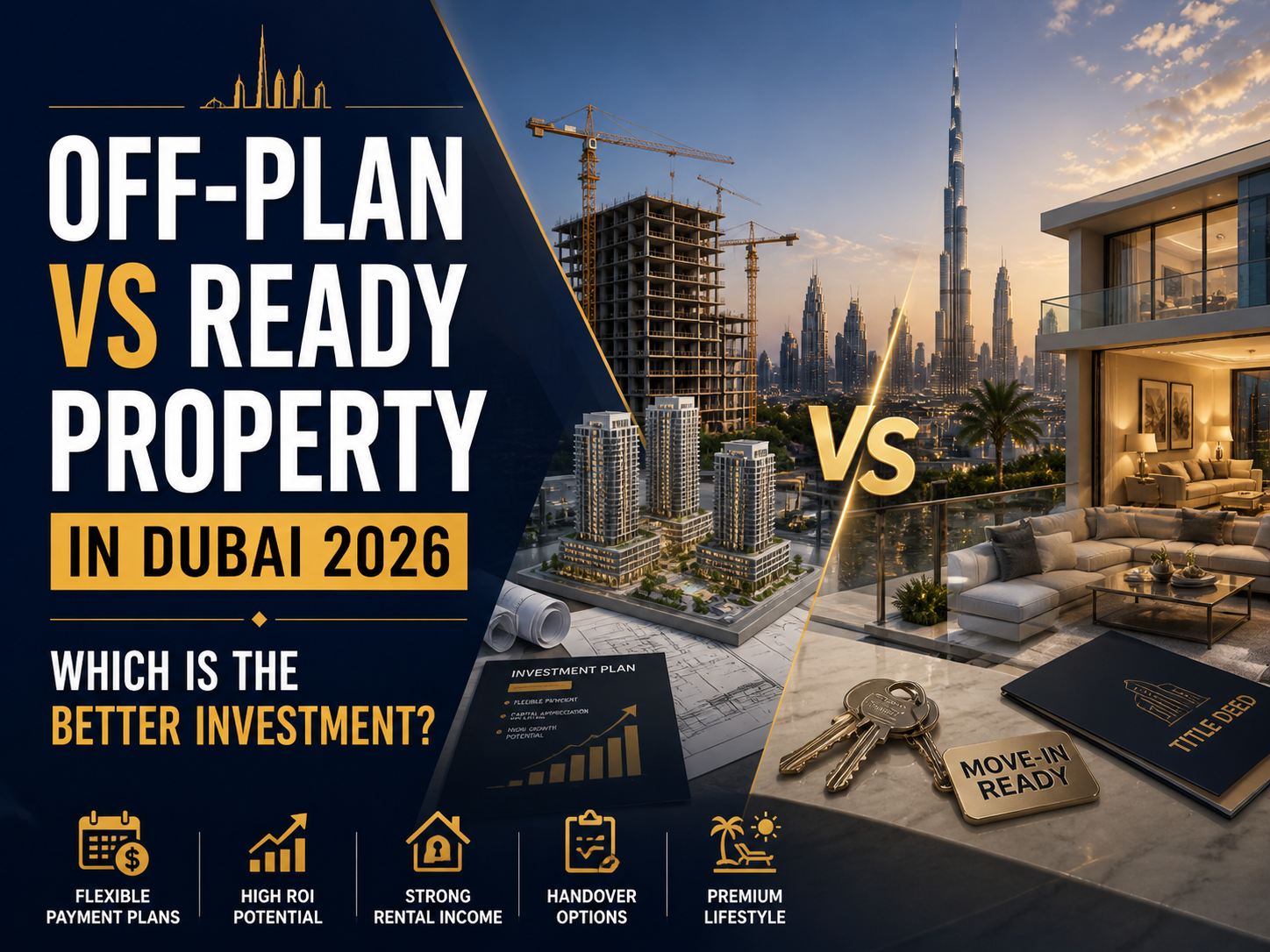
Off-Plan vs Ready Property
| Factor | Off-Plan | Ready Property |
|---|---|---|
| Entry price | Lower | Higher (market rate) |
| Payment | Instalments over construction period | Upfront or mortgage at transfer |
| Risk | Developer delivery risk | Lower — you see what you buy |
| Rental income | Only after completion | Immediate |
| Capital appreciation | Higher potential (if market rises) | Lower (you buy at market) |
| Typical timeline | 1–4 years to handover | Immediate transfer |
Off-plan checklist:
- Verify the developer's RERA registration and escrow account
- Check the developer's track record on previous projects (delivery timelines)
- Understand the payment plan terms and what happens if you miss a payment
- Inspect the Sales and Purchase Agreement (SPA) carefully — ideally with a lawyer
Mortgages for Expats in Dubai
Mortgages are available to non-UAE nationals from most major UAE banks. Key terms:
Loan-to-Value (LTV):
- First property under AED 5 million: maximum 80% LTV for expats (20% deposit)
- First property above AED 5 million: maximum 70% LTV (30% deposit)
- Second and subsequent properties: maximum 65% LTV
- Off-plan properties: typically 50% LTV or less
Interest rates: 3.5–5.5% per annum (variable and fixed options). Rates have moved with global interest rate cycles — get current quotes from multiple banks.
Mortgage registration fee: 0.25% of loan amount + AED 290, paid to DLD.
Banks offering expat mortgages: Emirates NBD, First Abu Dhabi Bank, Mashreq, HSBC, Abu Dhabi Commercial Bank, Standard Chartered.
Pre-approval: Always get mortgage pre-approval before signing an MOU. Pre-approval is typically valid for 60–90 days and confirms your borrowing capacity to the seller.
Visa Benefits Through Property
Dubai ties residency benefits to property investment thresholds:
| Investment | Visa |
|---|---|
| AED 750,000+ (property value) | 2-year renewable investor visa |
| AED 2,000,000+ (equity, not mortgage) | 10-year Golden Visa |
Important notes:
- For the AED 750K visa, 50% of the property value must be paid (i.e., mortgage of no more than 50% LTV)
- For the Golden Visa, the AED 2M must be in paid equity — mortgaged portions don't count until paid
- Multiple properties can be combined to reach thresholds
- Off-plan properties can qualify if approved by DLD
Golden Visa benefits: 10-year residency, ability to sponsor family, no minimum stay requirement, access to UAE banking and healthcare.
Service Charges: The Ongoing Cost
Service charges (maintenance fees) are paid annually to the owners association and cover building maintenance, security, and shared facilities. They are mandatory and enforced.
Typical service charges (2026):
- Apartment in Dubai Marina: AED 12–20 per sq ft per year
- Villa in Arabian Ranches: AED 4–8 per sq ft per year
- Premium tower in Downtown: AED 20–35 per sq ft per year
For a 1,000 sq ft apartment in Dubai Marina: approximately AED 12,000–20,000/year in service charges.
Outstanding service charges must be cleared before any property can be sold. They are attached to the property, not the owner.
Due Diligence Checklist
Before signing any MOU:
- Verify agent's RERA licence number on the RERA portal
- Confirm property is in a designated freehold zone (check DLD)
- Request a Title Deed copy from the seller — verify ownership matches
- Check outstanding service charges with the owners association
- Verify no existing mortgage on the property (request DLD printout)
- For off-plan: check developer's RERA registration and escrow account number
- Request 3 years of service charge statements to understand real ongoing costs
- Check RERA rental index for the area to validate investment return expectations
Top Investment Areas for Rental Yield (2026)
| Area | Average Gross Rental Yield |
|---|---|
| Jumeirah Village Circle | 7–9% |
| Dubai Silicon Oasis | 6–8% |
| Dubai Sports City | 6–7% |
| Business Bay | 5.5–7% |
| Dubai Marina | 5.5–6.5% |
| Downtown Dubai | 5–6% |
| Palm Jumeirah | 4.5–6% |
Gross yields. Net yields after service charges, maintenance, and vacancy are typically 1–2% lower.
Frequently Asked Questions
Do I need a UAE visa to buy property in Dubai?
No. You do not need UAE residency to purchase property. However, owning qualifying property can earn you a residency visa.
Are there property taxes in Dubai?
No annual property tax. No capital gains tax. No inheritance tax. The only mandatory fees are the 4% DLD transfer fee (paid once on purchase) and annual service charges.
Can I rent out my property on Airbnb?
Yes, but you must register as a holiday home operator with DTCM and obtain a permit for each unit. Some communities prohibit short-term rentals — check the community bylaws.
What is RERA and why does it matter?
RERA (Real Estate Regulatory Agency) regulates all developers, agents, and property transactions in Dubai. All agents must be RERA-licensed. All developer escrow accounts must be RERA-registered. Only deal with RERA-registered parties.
How long does the purchase process take?
Ready property: 2–6 weeks from MOU to Title Deed. Off-plan: MOU to handover can be 1–4 years depending on construction timeline.
Is now a good time to buy in Dubai?
The market in 2026 has seen strong price appreciation since 2021. Entry prices are higher than 3 years ago. Rental yields remain attractive by global standards. The correct answer depends on your specific purpose (own use vs investment), financial situation, and time horizon. This is where a licensed financial advisor adds genuine value.
This guide is reviewed annually. Last updated May 2026. Not legal or financial advice. Always consult RERA-licensed professionals.